Linen basics · Bedding
Linen Sheet Weight Explained: How GSM Shapes Feel and Drape
A number on a fabric specification can be useful without being a verdict. GSM helps describe the weight of linen sheets, but the way they feel in bed also depends on weave, finishing, fibre and care. Understanding those details makes it easier to read the label—and harder to be misled by a single figure.
Published 16 November 2026
There is a particular kind of confidence attached to a number. It appears precise, asks little of the reader and seems to settle a question before the fabric has even been touched. For bed linen, that number is often GSM: grams per square metre. It tells us how much a square metre of fabric weighs, and can offer a useful point of comparison between linen sheets. What it cannot do is describe the whole experience of sleeping beneath them.
A sheet is not a number laid flat. It is a structure made from yarns, crossings, finishes and decisions about how the cloth will be used. A heavier fabric may fall in a generous, substantial way; a lighter one may feel airy and move readily across the bed. Yet neither quality can be inferred from weight alone. Two fabrics with similar GSM can differ in softness, surface, opacity, breathability and the way they settle around a mattress.
That is why linen sheet weight is best read as context rather than a ranking. It gives a clue about material density and potential drape, but it is one clue among several. For anyone comparing linen bedding, the more revealing question is not simply, “How many grams?” It is, “What does this cloth’s weight mean in combination with its weave, finish and intended use?”
What GSM measures—and what it leaves out
GSM is short for grams per square metre. The measurement expresses the mass of a defined area of fabric: a square metre of cloth that weighs 180 grams has a fabric weight of 180 g/m². It is a standard way of describing textiles and is often useful when comparing materials within the same broad category.
For linen sheets, GSM can suggest whether a fabric is relatively light, medium-weight or substantial. A lighter cloth may feel less imposing and can be easier to move beneath; a heavier one may have more body and a more pronounced fall. These are tendencies, not guarantees. The same weight can behave quite differently depending on yarn size, weave density, finishing and the amount of space between the threads.
GSM does not measure softness. Nor does it directly measure durability, breathability, quality or the amount of flax in a fabric. It is not a thread count, and it should not be treated as a substitute for knowing the fibre content. If a specification says “100% linen,” that identifies the fibre composition; the GSM identifies the weight of the resulting fabric. They answer different questions.
Weight can also be reported in other units, such as ounces per square yard. When comparing products, check that the figures use the same system and refer to fabric rather than a complete bedding item. A sheet set’s total packed weight, for instance, is not comparable with a fabric’s weight per square metre. The distinction is simple, but it matters: sound comparisons begin with measurements that describe the same thing.
How weight influences drape
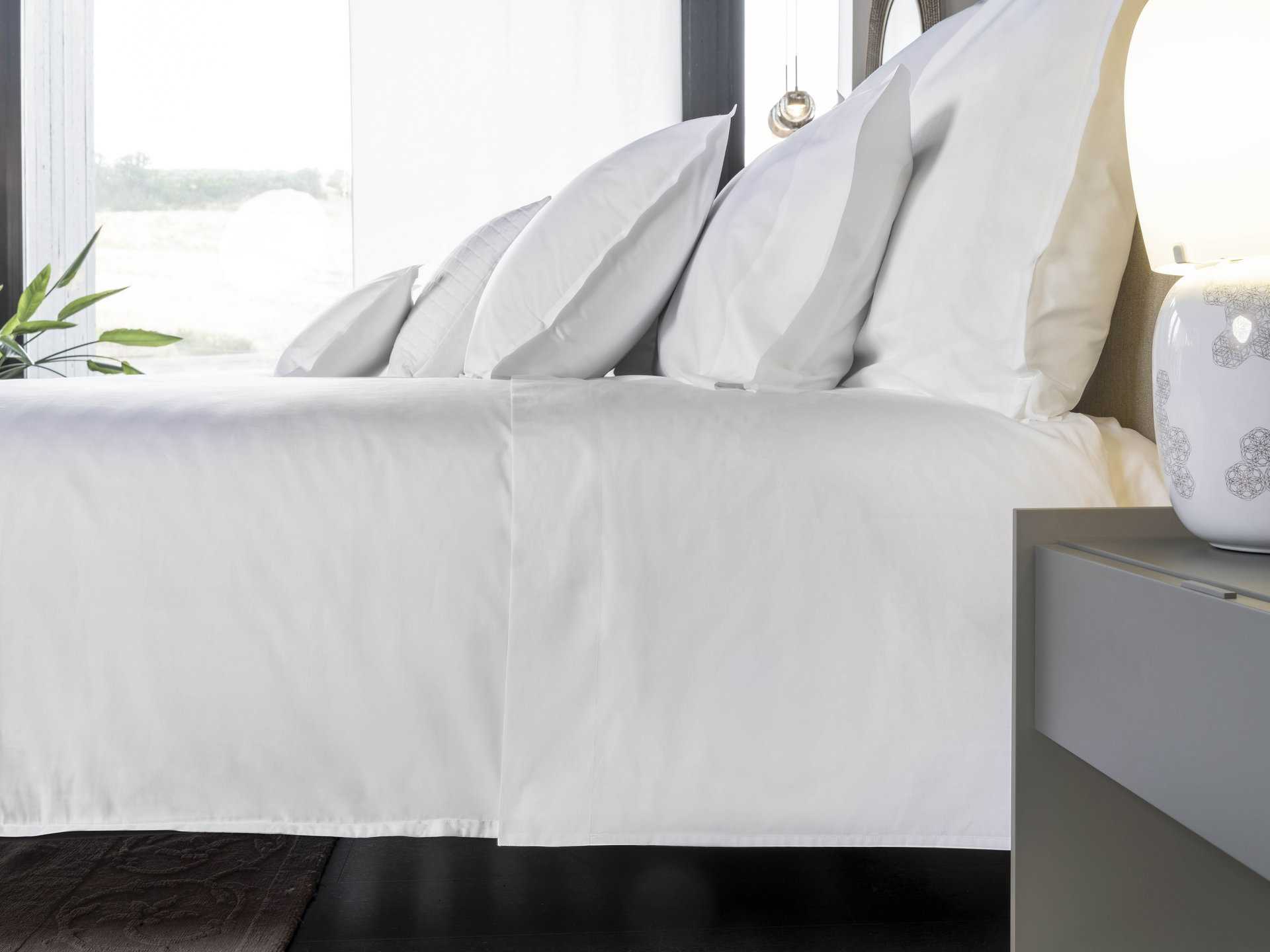
Drape is the way fabric falls, folds and responds to movement. It is partly a visual property, but it is also tactile. A sheet with a soft, fluid drape tends to settle close to the bed’s contours; one with more body may hold a broader fold or feel more present as it is pulled over the sleeper.
In general, increasing fabric weight can contribute to a fuller drape. There is more material in a given area, and the cloth may feel more substantial in the hand. But a fabric’s structure can change that impression. A loosely woven linen may feel open and pliant, while a more compact construction of similar weight can feel firmer. A wash or garment finish may relax the surface, making the sheet seem softer and less formal than its specification alone suggests.
Weight is therefore a useful starting point for imagining the sheet’s presence, not a complete account of it. Drape also depends on the relationship between the yarns and the weave. A fabric can be light yet have enough structure to hold its shape; another can feel supple because its finish has softened the cloth. The hand—the textile term for the way a fabric feels—is the result of several features working together.
On a bed, the practical effects are equally varied. A more substantial sheet may feel reassuring to someone who likes a defined layer. A lighter sheet can suit someone who prefers a less weighty covering or wants to keep the bed’s layers easily adjustable. Mattress depth, room temperature and the rest of the bedding ensemble also influence how a sheet behaves in use.
Weight and the feel of linen
Linen is made from flax, and its surface has a character that is distinct from cotton, silk and many synthetic fibres. Linen yarns and woven cloth may show small irregularities that are part of the material’s appearance. The result can be crisp, dry, relaxed or softly rumpled, depending on the yarn, construction and finish. GSM helps describe how much cloth is present; it does not explain those details by itself.
Many people associate linen with a cool, breathable feel. Air movement and moisture management are connected to the fabric’s construction and fibre characteristics, but a GSM figure alone cannot promise a particular sleeping temperature. A lighter weight may feel less enveloping, while a heavier sheet may create a more substantial layer. Yet room conditions, the sleeper’s preferences and what lies above and beneath the sheet all contribute to comfort.
It is worth resisting the notion that the lightest linen is necessarily the most breathable, or that the heaviest is necessarily the most durable. A fabric’s open or compact construction matters. So does the quality and preparation of the yarn, as well as the finish applied after weaving. Weight is an attribute, not a complete performance test.
Softness is especially easy to misread. Linen often changes with use and laundering, and a sheet that feels crisp when new may soften over time. Some fabrics are washed or treated to produce a gentler feel from the outset. If one sheet is described as “relaxed” and another as “crisp,” those words may tell you more about its finishing and intended character than a modest difference in GSM.
Weave and finishing: the other half of the story
Weave describes how the lengthwise and crosswise yarns interlace. It affects the cloth’s surface, structure and movement. Linen bedding can be made in different constructions, and even where the fibre is the same, those constructions can produce noticeably different results. A smooth, compact fabric may feel different from one with a more open, textured structure, regardless of whether their weights are close.
Finishing describes processes carried out after weaving, and sometimes after dyeing, to modify the fabric’s appearance or hand. Washing can relax the cloth and soften its initial feel. Stonewashing, garment dyeing or other treatments may create a more lived-in surface or tonal variation. Finishing can also affect how much a sheet creases, how it drapes and whether it feels crisp or easy from the first night.
This is one reason two linen sheets with similar GSM may not seem similar at all. One may have a smooth, neat surface; another may be deliberately textured. One may be sold in a washed state; another may arrive with a firmer hand. Neither description is inherently superior. The useful question is whether the material’s character matches what you enjoy using.
Construction details matter, too. A fitted sheet’s elastic, pocket depth and cut determine how securely it sits on a mattress. A flat sheet’s dimensions influence how much fabric can be tucked or folded back. These are not measures of fabric quality, but they affect the sheet’s usefulness and perceived weight in daily life. A sheet that is too shallow for a deep mattress may pull taut; one with generous dimensions can drape more freely.
How to compare linen sheets thoughtfully
When comparing linen sheets, begin with the information that identifies the material and its construction. Look for the fibre content, the stated fabric weight and the country or place of manufacture if provenance is important to you. Then read the description of the weave and finish, followed by the care instructions. The details are more informative together than any single specification is on its own.
- Check the units. Make sure weight is given as GSM or another fabric-weight measure, rather than the total weight of a set.
- Confirm the fibre content. “Linen” may describe a product’s style or feel in casual language; a fibre statement clarifies whether it is 100% linen or a blend.
- Read the finish description. Washed, stonewashed, garment-dyed and crisp-finish fabrics can have different hands and appearances.
- Look beyond the number. Consider weave, yarn and construction alongside GSM rather than treating weight as a quality score.
- Check dimensions and fit. For fitted sheets, pocket depth and mattress size affect how the fabric sits and moves.
- Review care guidance. Washing and drying recommendations influence how a sheet ages and how much attention it requires.
For instance, a reported weight of 190 g/m² gives a reader a point of reference, but the number does not tell the whole story of a particular sheet. The Heritage Flatsheet in the site’s bedding information is described as 100% organic linen, woven in Belgium with European flax yarn, with a natural drape and matte finish; its stated weight is 190 g/m². Those additional details help create a more useful picture than the measurement alone. The figure identifies the fabric’s weight, while the fibre, origin and finish suggest other aspects of its character.
Comparisons should also account for the purpose of the item. A sheet intended as a year-round foundation is not necessarily trying to do the same job as a decorative coverlet or throw. In a bedding ensemble, each layer has its own role. A fitted sheet, flat sheet and coverlet may differ in weight because they are designed to sit in different places and serve different functions.
Does heavier linen mean better linen?
No single fabric weight can establish that a sheet is better. A higher GSM may indicate more material per square metre, but quality is broader than mass. Fibre selection, yarn preparation, weaving, finishing and stitching all contribute to the finished textile. So do the accuracy of the product description and the care required to keep the sheet in good condition.
Heavier fabric can be a good choice for someone who likes a more substantial feel, a pronounced drape or a sheet that feels like a clear layer on the bed. A lighter fabric may be preferable for someone who wants an airy, less weighty surface. Preference is not a concession to quality; it is part of the specification that matters most in daily use.
It is also unwise to assume that heavier fabric will automatically last longer. Durability depends on the strength of the yarns and the cloth’s construction, among other things. A well-made lighter fabric can be durable, while a heavier one can still be damaged by harsh washing or over-drying. The most dependable evaluation combines the stated material and construction with a realistic care routine.
In other words, the question is not whether a higher number is more impressive. It is whether the fabric’s weight, finish and use make sense together. A sheet should work with the bed, the climate of the room and the habits of the person sleeping in it.
Care can alter the way weight feels
GSM describes the fabric as specified; it does not predict every change that will come with laundering. Over time, washing can soften linen and alter the way it falls. Drying methods, detergents and heat can also influence the surface and the life of the cloth. Following the maker’s instructions is the most reliable route to preserving the intended character of a sheet.
Many linen care instructions favour a gentle wash and moderate temperatures, with line drying preferred where practical. Some sheets may be tumble-dried on a low or medium setting; others call for more delicate handling. These instructions differ, so a general rule should never override a specific label. Avoiding excessive heat and over-drying can help limit unnecessary stress on fibres and reduce pronounced creasing.
Ironing is a matter of preference as much as maintenance. Linen’s relaxed creases are part of its familiar appeal, and a sheet need not be pressed to be cared for properly. If a smoother finish is wanted, steaming or ironing while the cloth is slightly damp may be recommended for particular items. Again, the care label takes precedence: the aim is to maintain the fabric, not to impose a uniform appearance on it.
Washing habits are part of the long view. A textile that is used and cared for in accordance with its instructions may become softer and more familiar with time. Care cannot make every sheet identical, any more than a GSM figure can. It is one part of the relationship between fabric and use.
What about thread count?
Thread count is sometimes brought into linen comparisons because it appears frequently in discussions of cotton bedding. It describes the number of threads in a defined area of woven fabric, though the way it is counted and presented can vary. It is not the same measure as GSM. The two describe different aspects of a textile, and one should not be used to translate or replace the other.
For linen sheets, a focus on thread count alone can distract from more revealing information: fibre content, weight, weave, finish and care. A fabric specification is most useful when its terms are understood in context. GSM describes weight per unit area; thread count concerns thread density as reported by the maker. Neither, by itself, is a complete measure of comfort or quality.
When shopping, the practical goal is not to collect the largest number. It is to understand what each number can and cannot tell you. If a brand provides a clear weight and detailed construction information, those facts can help you compare like with like. If key details are missing, a high-sounding figure cannot fill the gap.
A useful reference point: Libeco and European linen
Libeco is a well-known Belgian linen maker whose work can serve as a reference when considering how provenance and textile construction enter the conversation. The name is associated with Belgian linen and European flax, but an origin or label should still be read alongside the particulars of an individual fabric. Different products may have different weights, weaves and finishes, even within the same maker’s range.
That distinction is central to comparing linen bedding. A recognised maker’s name can provide useful context, but it does not make GSM unnecessary—or make GSM decisive. Read the specification of the actual sheet: its fibre content, weight where provided, construction, finish and care instructions. The fabric itself, rather than the reputation attached to it, is what will meet the sleeper night after night.
Provenance can matter for reasons beyond feel. Readers may want to understand where flax was grown, where yarn was woven or where a finished item was made. These are separate stages in a textile’s journey, and product descriptions do not always use the words “European,” “Belgian” or “made in” to mean the same thing. Where that distinction is important, look for explicit information about each stage rather than assuming that one geographic label explains all of them.
A simple way to make the choice
Before choosing linen sheets, imagine the sensation you want from the bed. Do you prefer a light layer that can be shifted easily, or a cloth with more substance and a stronger drape? Do you like a crisp, ordered surface, or a softer, rumpled one? These questions describe use and preference more directly than “Which GSM is best?”
Then use the specification as a guide. Compare weights when they are reported in the same units, and keep the comparison within a similar kind of product. Look for fibre content and finish. Check dimensions, especially if selecting a fitted sheet for a deeper mattress. Finally, read the care directions and consider whether they fit the way you do laundry.
The Organic Relaxed Linen Fitted Sheet illustrates why those details belong together: it is described as 100% organic flax linen, with a 15-inch-deep pocket, full elastic, a plant-based softener and a care routine that calls for a cold, gentle machine wash and low tumble drying. The description gives practical information about fibre, fit, finish and maintenance, even though a GSM figure is not supplied. That absence is not a reason to invent one; it is a reminder that a thoughtful comparison should use the information available and distinguish it from what remains unspecified.
The same discipline applies to any sheet. A number should be recorded as a number, not transformed into a promise. If GSM is provided, use it to understand relative weight. If it is not, rely on the other stated details and, where possible, your own experience of the fabric. What matters is not a complete spreadsheet of measurements, but a clear sense of what the cloth is and how it is likely to work in your home.
The measure is useful; the fabric is richer
GSM offers a straightforward way to describe linen sheet weight. It can help readers compare fabrics, anticipate whether a sheet may feel relatively light or substantial, and understand the potential influence of weight on drape. It is worth knowing, and it is worth checking when the information is available.
But GSM is not a verdict on softness, breathability, durability or quality. Those qualities emerge from the interaction of fibre, yarn, weave, finish, construction and care. Linen’s appeal lies partly in that complexity: it can be crisp or relaxed, open or more compact, light in presence or generous in drape, while remaining recognisably linen.
The best comparison is therefore a patient one. Read the number, then read the rest of the label. Ask what the sheet is made from, how it was woven and finished, how it is cut to fit, and what its care instructions ask of you. Weight can begin the conversation. The cloth, in use, completes it.
Key points at a glance
- GSM means grams per square metre and describes fabric weight, not the complete bedding item.
- Weight can influence a sheet’s sense of substance and drape, but it does not determine softness, breathability or durability on its own.
- Weave, yarn, finishing and dimensions all affect how linen sheets feel and perform.
- Compare like with like, check fibre content and care instructions, and choose according to personal preference rather than chasing the largest number.